

This is another travel guide section from close to the end of Ez’s trip - after taking a train from Nimes to Puy-en-Valey he walks through Auvergne, to Clermont-Ferrand, the final city of the trip and home to various troubadours. ‘The Point of the Book’ and the setting of the final Canto takes place in a village just north of Puy, Allègre (‘joy’), following Puy in this extract.
Ez would have been one of the very first passengers on the railway between Langogne and Puy, opened on the 1st of July 1912. The train he took to Langogne still runs, but the branch north across Velay to Puy was progressively closed from the 1980s. Today some of it is a ‘cycling railway’ and the rest a footpath, and since a recent landslide the main railway has been replaced by a dedicated bus.
Accordingly, I did not take it, arriving in Puy by way of Lyon and Saint-Etienne, a route that cuts single file through the valley of the Loire and which, I had to admit, looked vaguely Chinese. I sincerely tried to like the latter of those two towns, and even if I possess the old immemorial right of lying I must freely admit I failed spectacularly. Please also bear in mind that your correspondent has only good things to say about Hull.
In what is treated as a comic accident, apparently part of life when travelling by train in 1912, part of Ez’s train derails and he has a multi-hour delay. He doesn’t speak of any injuries or deaths (and surely even he would have, had there been any) and the incident is shrugged off. Professions like train driver had a whiff of daring in those days – today they are criminal strikers, and in France have managed to win for themselves not just limitless free travel but a card for their significant other giving 90% off all bookings. The Anglo-Saxon in me just waits to gloat at automation but I think there are more just targets; railway staff –– outside of Paris, where they are atrocious ––– are mostly polite, and normally somewhat helpful. It doesn’t seem to go to the head quite as severely as in the UK, where there is no more petty state employee than the one that stalks the railway.
However he gets there, eventually he does. From the start Puy is not likely to impress M. Ez. A Catholic city, its bishop Adhemar de Monteil personally leading the First Crusade, fighting in Antioch, Puy was a religious centre back to Gallo-Roman times, churches improbably plopped on top of one its little puechs or plugs. Later Puy had its own Rienzi; Durand, a carpenter who received a vision from God and founded the Confrérie des Encapuchonnées, an armed band who fought against routiers pillaging the countryside. We are still a century before Werner and his ‘Enemy of God, of Pity and of Mercy’; but the situation of the south from 1100-1300 was comparable to that of Italy just afterwards. In fact, everything unique about that period happened here first, in a rougher and more obscure fashion, a point I’ve made already multiple times and will probably do so again. Routiers, often Flemish, were a menace throughout the south and particularly so since Toulouse hired mercenary troops and left them unemployed each winter to rape and steal.
For decades, dependence on mercenaries was a common charge brought against the Raymonds by the local Church, alongside stealing their property, and though the crusaders would go on to cause equal amounts of chaos, these bands of German and Dutch mercenaries failed to produce grand captains on the later Italian model. Apparently an armed, popular movement, the Hooded Brotherhood had an initial aim of enforcing the various de jure truces, and, much like Rienzi in his first rise to power, had the whiff of clerical approval. From its founding in 1184, the armed sect spread rapidly throughout the south, slaughtering thousands of mercenaries before the Church and nobles recognised its revolutionary character and had them all killed in turn.
It is remembered today as a ‘peace movement’. I am not sure, but given the usual placidity of peasants in face of mass slaughter and billeting, things they have always secretly enjoyed, I suspect the Brotherhood was –– at least initially –– Church-funded, its paymasters turning on it when it grew out of control. That said, in an era of popular crusades it is possible a talented preacher could simply whip up a crowd and form a small army around himself.
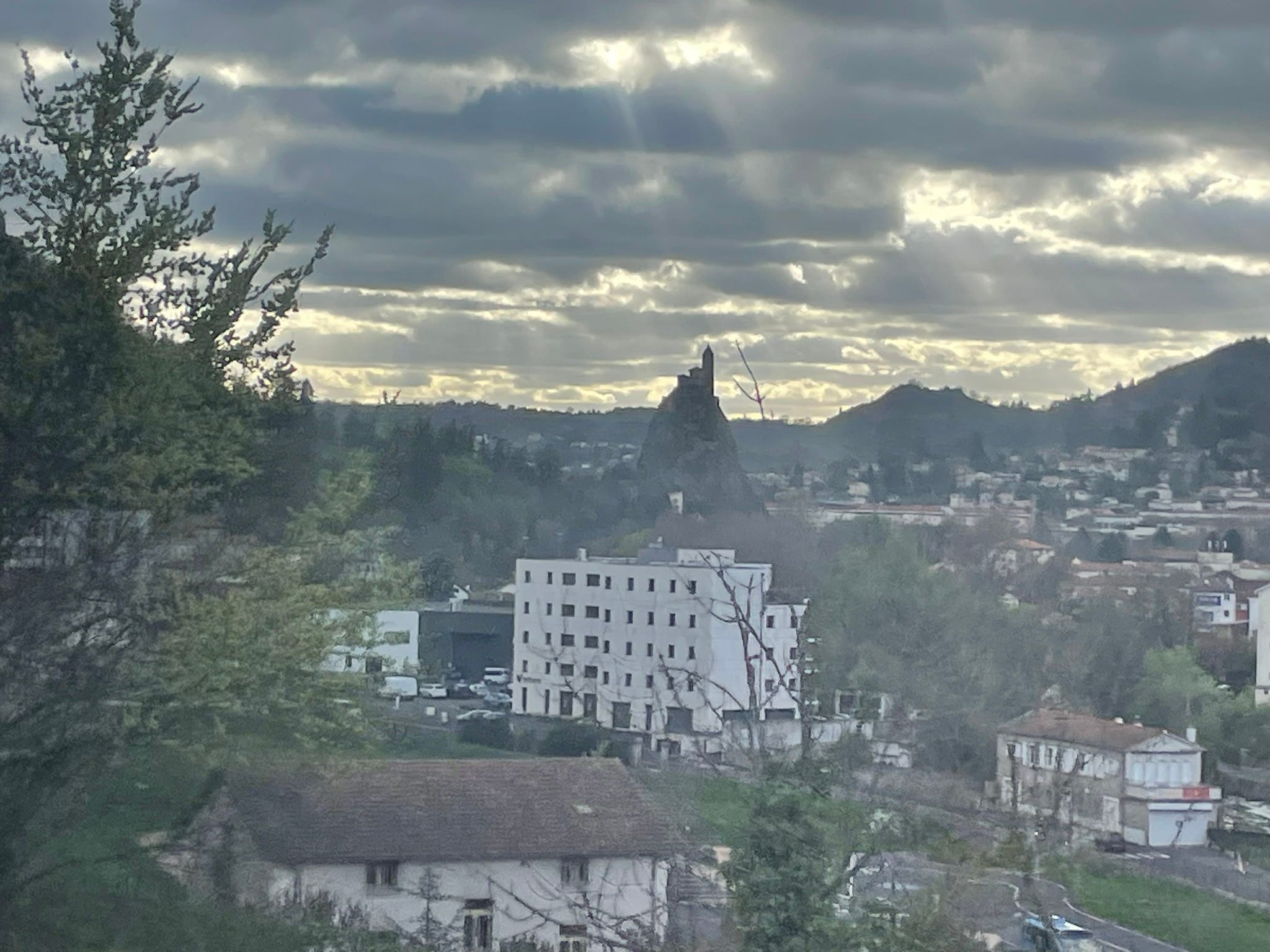
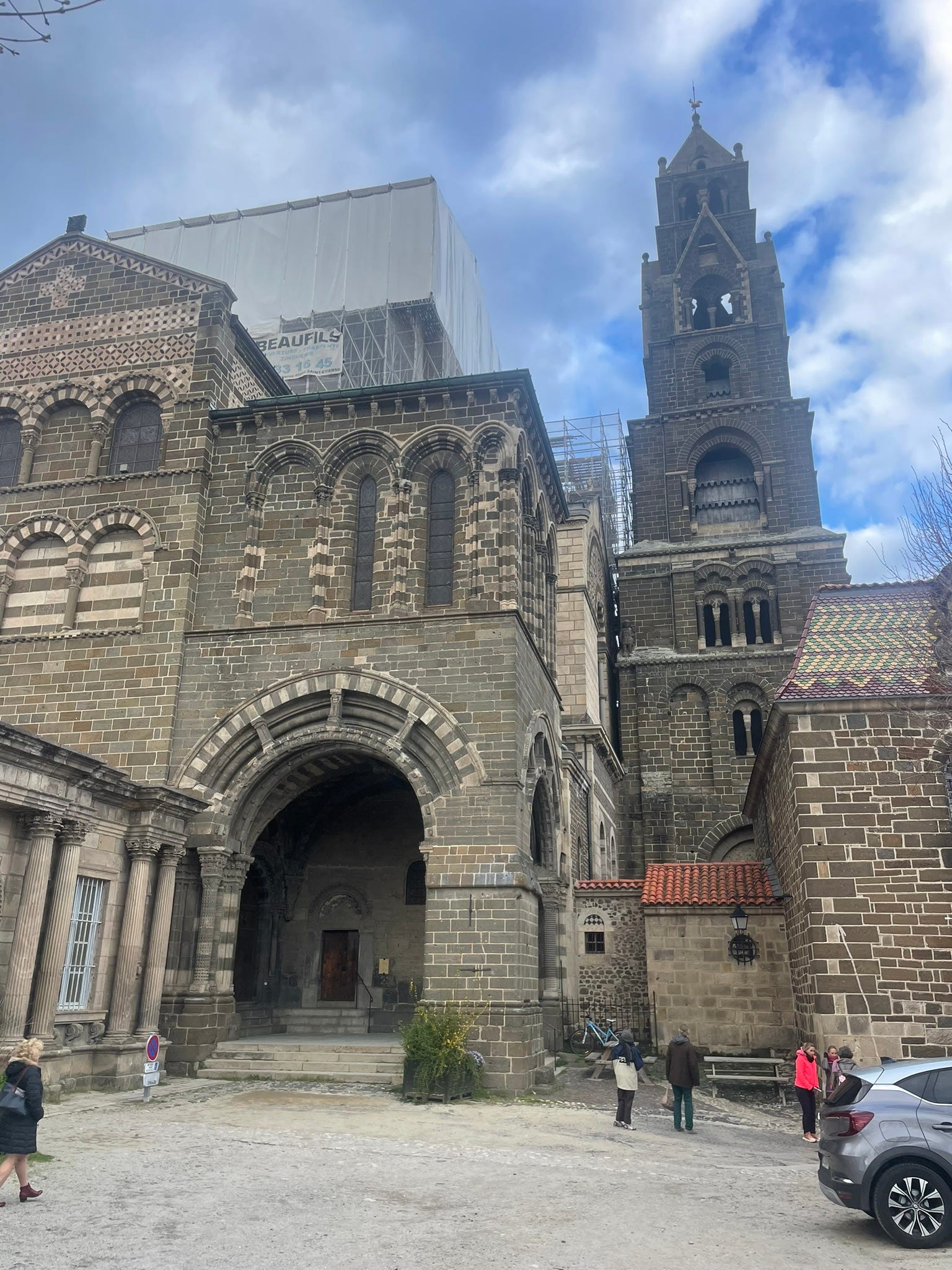
What is Puy now – it is twinned with Tonbridge, which they mistakenly call ‘Tonbridge and Malling’ on the sign at the entrance – Puy has less charm than that city, less charm and more tourists. I will begin with its defence; it’s always interesting to see genuine mass religiosity, and Puy is stuffed with mediaeval seeming characters like pilgrims and nuns –– to some tastes the churches may be beautiful ––– all can admit they are set remarkably on their hills. Smith, Pound and everyone else point out it looks Spanish, southern Spain in particular, apparently the cathedral very similar to a mosque in Cordoba. But whatever the charms of that southern city, here it doesn’t work –– Velay a high plateau, green with cows and forests ––– the black stripes and crenellations seem absurd, alien. The overall mood of the town is subdued, I was there once as a child in summer and it was frenetic – or at least was so in my imagination – but in April the city is dead. Puy, whatever else we say about it, is perhaps the only French city where I didn’t see a kebab shop.
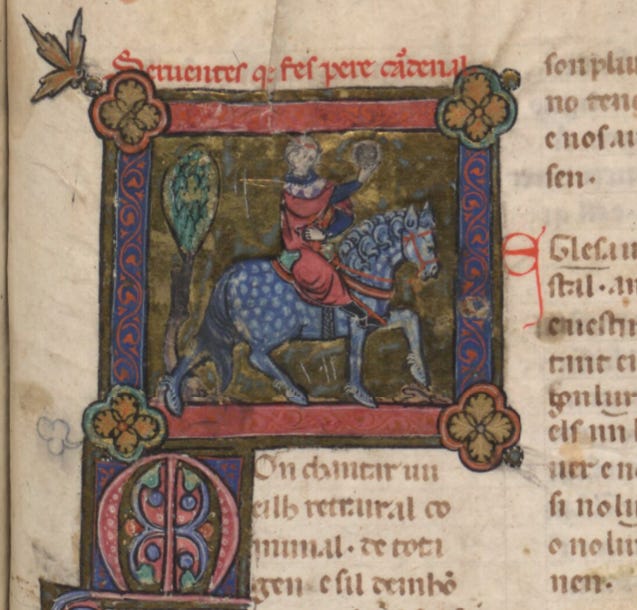
Ez predictably hated Puy, despite the city being home to a poet he admired greatly, Peire Cardenal. Peire was a noble, whose experiences with local clergy appalled him into a career as a satirist. I must point out that personally, the Church party were perfectly kind to me, after Yorick they know enough to mollify English tourists on sight, their representative, a lady – not a religious, but quite proper all the same – sweetly explained to me she had closed the cathedral 30 minutes early to go home. Imagining disappointment in my face, she then went out of her way to encourage me to attend the 7am pilgrims’ mass, offering free shell necklaces and other such tat, before pointing out that even if I wasn’t going to St James’ shrine it was still, in her words, a pilgrimage of a sort. I thanked her and set my alarm for 7:30.
Peire Cardenal was one of the last great troubadours, vying for that sad title with Guiraut Riquier, the master of Narbonne. Below is a classic satire by Peire, showing much invective, aimed as much as slow payers as his moral opponents. Cardenal has genuine force, this kind of satire is extremely difficult to do and makes demands on the character of the singer – never a welcome requirement for a poet. The sirventes below, which is simple in Occitan, is hard to translate because of its split between greu and leu, mixed descendants of gravis and levis, heavy and light, but with the sense of doing something with reluctant difficulty versus ease, greu (via French) becoming English grief. Eventually, Ez solves the problem quite adequately with rathe to destroy, niggard in charity. Cardenal is a satirist, and so opposed to the spirit of his times, his description of the elite (probably in this case a military lord, rather than his usual targets in the Church) gives us an idea what was expected in noble behaviour in the aftermath of the Albigensian Crusade.
We begin with his vida:
Peire Cardinal si fo de Veillac, de la siutat del Puei Nostra Domna ; e fo d’onradas gens de paratge, e fo filz de cavallier e de domna. E cant era petitz, sos paires lo mes per quanorgue en la quanorguia major del Puei ; et apres letras, e saup ben lezer e chantar. E quant fo vengutz en etat d’ome, el s’azautet de la vanetat d’aquest mon, quar el se sentit gais e bels e joves. E molt trobet de bellas razos e de bels chantz ; e fetz cansos, mas paucas ; e fes mans sirventes, e trobet los molt bels e bons. En los cals sirventes demostrava molt de bellas razons e de bels exemples, qui ben los enten ; quar molt castiava la follia d’aquest mon, e los fals clergues reprendia molt, segon que demostraron li sieu sirventes. Et anava per cortz de reis e de gentils barons, menan ab si son joglar que cantava sos sirventes. E molt fo onratz e grazitz per mon seingnor lo bon rei Jacme d’Arragon e per onratz barons.
Et ieu, maistre Miquel de la Tor, escrivan, fauc a saben qu’En Peire Cardinal, quan passet d’aquesta vida, qu’el avia ben entor sent ans. Et ieu, sobredig Miquel, ai aquestz sirventes escritz en la ciutat de Nemze.
Et aqui son escritz de los sieus sirventes.
Which reads :
Peire Cardenal was from Velay, the city of Notre Dame de Puy, he was a nobleman of real worth, and the son of a knight and lady. And when he was still small, his father had him enter into the canonry at Puy, where he learned grammar, and to read and sing well. And once he became a man, he was won over by the vanity of this world, feeling joyous, handsome and fair. And he composed discourses and sweet songs, composing cansos, but few, but many sirventes, with fine words, well placed. And he showed himself wise and made fine examples, which were well-received – he chastised the folly of this world, writing much against the false priests, as you will see in this sirventes. And he attended the courts of kings and of great barons, travelling with his joglar who sung the sirventes. And he was well honoured and much loved by my lord, the good King James of Aragon, and by honourable barons.
And I, master Miguel de la Tour, writer, make it known that when Peire Cardenal passed on from this life he had lived around 100 years. And I, who they call Miquel, have recorded this sirventes in the city of Nimes.
And here is his sirventes:
Ricx homs que greu ditz vertat e leu men,
e greu vol patz e leu mou occaizo
e dona greu e leu vol c’om li do,
e greu fa be e leu destray la gen,
e greu es pros e leu es mals als bos,
e greu es francz e leu es ergulhos,
e greu es larcx e leu tol e greu ren,
deu cazer leu d’aut loc en bas estatie
A rich man, slow to tell truth but who lies lightly
Slow to want peace, who kills without a thought
Hesitant in giving, demanding of gifts
Willing no good, always quick to destroy
Without merit, except in wronging the worthy
Never frank, prideful
Ungenerous, he takes lightly and returns nothing
He must fall from on high, to a lower estate.
De tals en sai que pisson a prezen
et a beure rescondons d’inz maizos,
et al manjar non queron companhos
et al talar queron ni mays de sen,
et a l’ostal son caitieu e renos
et a tortz far son ricx e poderos,
et al donar son de caitieu prezen,
et al tolre for e de gran coratge
I know those who piss out in the open,
But drink hidden away in their houses,
They do not search for dinner companions,
But to destroy, seek out more than a hundred,
At home they are mean, churlish
But in their crimes they are rich and significant,
They give miserable gifts,
But take with strength and courage.
Malditz es homs que∙l be ve e∙l mal pren,
et e∙ls ricx an pres orgohls e trassios;
et an laisat condutz e messios
et an pres dans e grans destruimen;
et an laissat lays e vers e chansos
et an pres plag e novas e tensos
et an laissat amors e pretz valen
et an pres mal voler e far otratge
Those men are cursed, who see good and choose evil
The rich who choose pride and treason,
They have abandoned good conduct and their calling
And instead chosen crime and rapine
Abandoning lays, poetry and song
They have replaced them with novels and debates
Abandoning love, virtue and worth
They chose evil, theft and outrage.
Aisi can son major an peior sen,
ab mais de tort et ab mens de razo,
ab mais de dan tenir ab menz de pro,
ab may d’orguelh ab mens de chauzimen,
ab mais de tolre et ab mens de bels dos,
ab mais de mals ab mens de bel respos
ab mais de mietz ab men d’ensenhamens,
ab mais deman ab mens de franc coratge
And so the greater they are, the less their sense,
With more wickedness, and less intelligence
Causing more suffering, with less reason,
More prideful, with less distinction,
The more they take, the fewer gifts they give,
With more evil, and less fine repose,
Chopping things up, with less learning,
Demanding more, but without fine courage.
Aras digatz, senhors, al vostre sen,
de dos baros cals a melhor razo
can l’un dels dos pot dar e tolre non
l’autre pot tolre dar non pot men?
e dizon motz que∙l dar val per un dos,
pueys vezem los tolre totas sazos;
a que far doncx van emblan ni tolen,
pus lo donars a dos tans d’avantatge
And so lords, tell me your opinions,
Of two barons, who has the most sense,
One who can give, but will not take,
Or the other who can take, but will not give?
They say to give makes two of one,
But we see them taking all the time,
Why then are they always stealing,
When to give offers twice the advantage?
Mos chantars es enuetz als enveios
et als plazens plazers qui platz razos;
tug li dig son plazen et ennos
so cals us platz als autres es salvatge
My songs annoy the envious
And give pleasure to the happy ones who are reasonable;
All words give pleasure or annoy
Those which please one, horrify another.
We can –– speculatively –– infer that Peire was finding it harder to extract gifts from the northern barony, who seem to have acted roughly in line with the Germans in Italy a century or so later. He is already lionising the old southern nobility ––– all of these criticisms could apply just as easily to Guillaume des Baux, with the significant exception of poor giving. Even for a genuine moralist like Cardenal, the main sin of the northern barons was their shoddy payments – a crime that even the greediest southern nobles knew never to commit. As sung an ancient, anonymous Irish poet:
I have heard he doesn’t give horses for poems;
he gives the thing that fits his nature: a cow.
Which is still better than nothing. Also interesting is Peire’s attack on new genres including the nova, known in France as the roman, which also existed in the south as in the famous nova del papuagay, the story of the parrot, or the tenso, a debate poem where troubadours argued over a set topic. It is probable these genres were better loved and rewarded by northern nobility, perhaps being closer to north French poetic forms than the canso or sirventes.
Allègre
Once more in Delos, once more is the altar a-quiver.
Once more is the chant heard.
Once more are the never abandoned gardens
Full of gossip and old tales
Surgit Fama, 1916
La faillite de Francois Bernouard, Paris
or a field of larks at Allègre,
‘es laissa cader’
so high toward the sun and then falling,
‘de joi sas alas’
to set here the roads of France.Two mice and a moth my guides –
To have heard the farfella gasping
As toward a bridge over worlds.
That the kings meet in their island,
Where no food is after flight from the pole.
Milkweed the sustenance
As to enter arcanum.To be men not destroyers
Canto CXVII (End)
The approach to Allègre is the end of the book, and where our odd pilgrimage had its most obviously superstitious character.
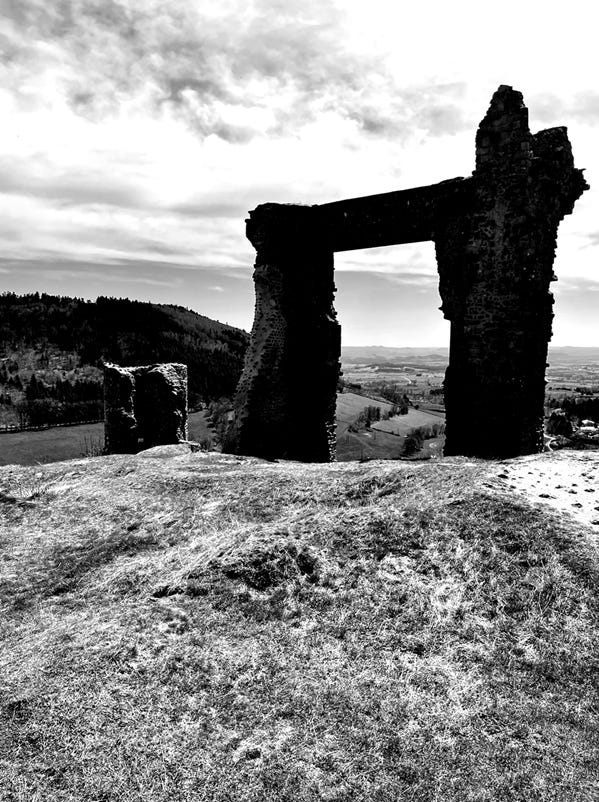
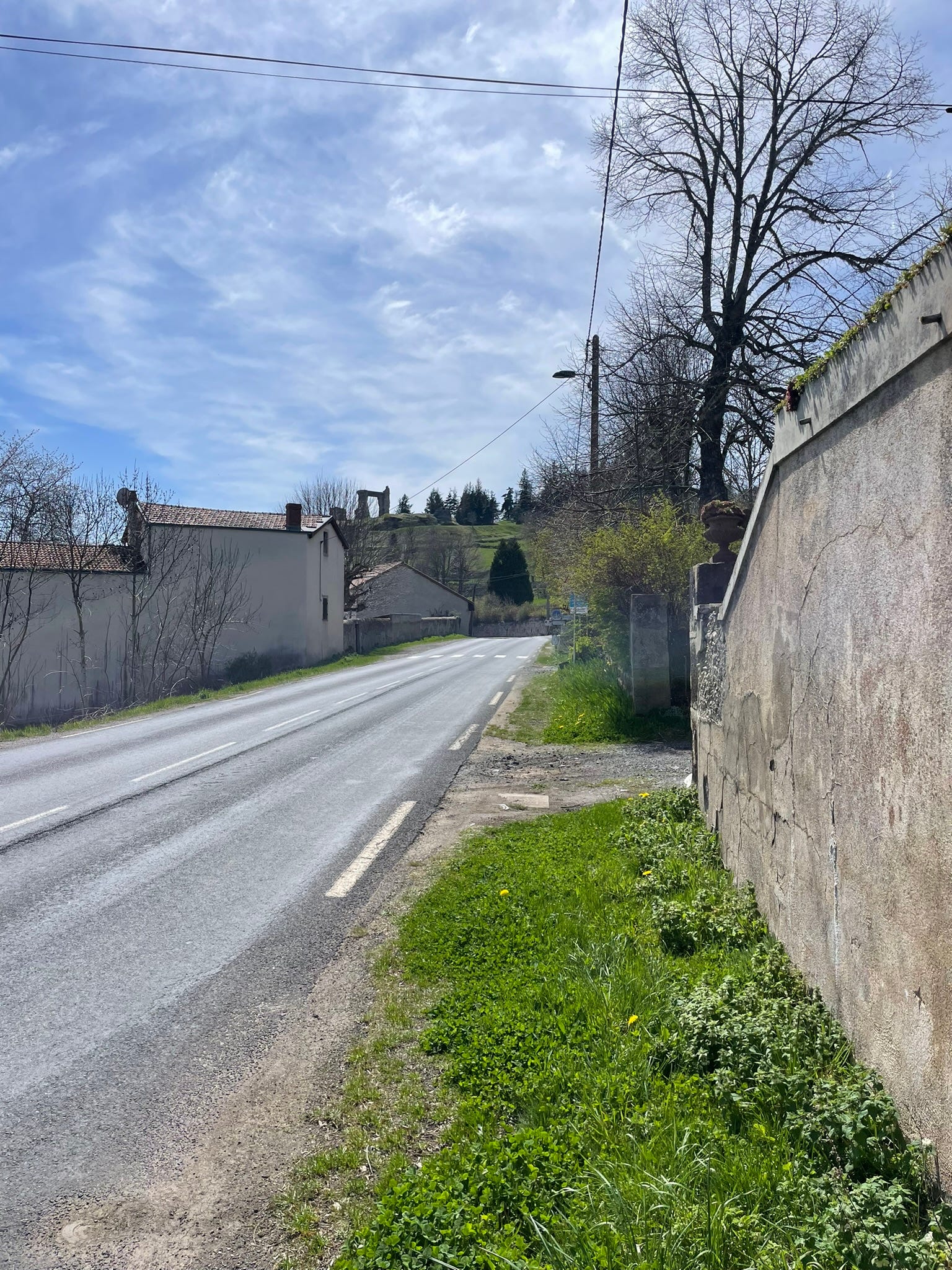
Ez quotes Bernard de Ventadorn here – calling him, in a bizarre backhander to Guillaume IX, Marcabru and a handful of others, the first great ‘finder’. This opinion, as Ez’s sometimes are, is indefensible, and I doubt even he would’ve defended it a few years later, coming as it does in The Spirit of Romance (1910), and before long eulogies on Arnaut Daniels, Bernard’s effective opposite. Ez may have been a victim of his own focused reading. But it’s a nice poem, the lark letting himself fall, and I was pleased to cross a few fields of them on the way to Allègre. Allègre is perfectly set, tucked next to a volcano with the gallows visible from many kilometres at the high point of the village. For various reasons – the front cover of the published version of Ez’s notes, the last Canto, etc etc – I had decided this was the main portal to the south, and the high point of my journey, but it still seemed unfamiliar in person, larger than I’d imagined, in better repair; but a highly functional portal nonetheless. Foolishly, I crossed it from south to north and afterwards lost all interest in my subject.
This is one of the focal points of his paradiso terrestre. Do not move. Let the wind speak. Ez’s 1912 notes, inevitably unaware of the eventual significance the place would have for him, show mere interest, Uzerche more remarkable to him. But Allègre and its association, perfect in its obviousness – Can vei la lauzeta mover is the Nessun Dorma of troubadour songs – is the hidden work of the trip, the stone he stumbles across, his gateway to paradise. In the end, Ez sides decisively with the leu against clus, Arnaut appearing only as a figure, a title, while the plebian immediacy of Bernard forms the capstone and summit of his poem. In a superstitious mood, I counted the larks, and noted a dead sparrowhawk and curled-up house cat in the slaughter-ditches of a departmental road, the D999. To make Ez speak we must feed him with blisters; I kept on walking, reaching Chaise-Dieu by the evening.
In Allègre an overweight man and a woman I assume was his daughter served a four course meal for €17; she seemed so happy to see someone who wasn’t a 55 year-old cyclist her father ended up faintly embarrassed (I had no blameable part in this). At Saint-Genes-la-Tourette I passed a church with hanging ropes instead of a door; Jeanne d’Arc is always conspicuously placed next to the church entrances here, and I felt mildly attacked. These cheap painted statues are one of the abominations of French Catholicism; perhaps we judged too swiftly the iconoclasts – it seems suspicious that amidst all the destruction so few named and notable pieces were lost. One suspects a sensible clean out, a bonfire of ugly and second-rate vanities, has been spun by the Catholic lobby into the fire at Alexandria.
I may say only trivial things about Allègre in this fashion because it is the point at which the ladder ends and the ascension is complete. Afterwards nothing compares, not even Allègre. I cannot necessarily recommend it to visit; this section of the walk was the most athletic and the most hurried, all of which contributed to the eventual cloud of unknowing about the place. It is not a town with serious connections to any old troubadour, although this is always guesswork and given its age it is likely they were ‘around’ at some point. But it is the final point in the grand poem, and everything which follows it in my little book of tribute feels petty. It would have been a mark of respect and moral seriousness to stop here – instead, having reached the summit, we shall injure our knees on appreciating descent.
I once went here and streets were filled with dog poo. Decline